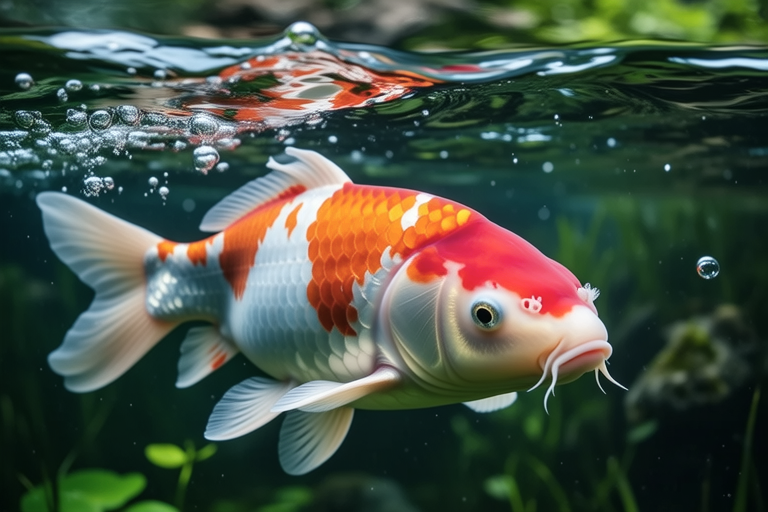
Breathtaking Beauty: Showcasing the Most Vivid Koi Varieties
Koi, or Nishikigoi, are ornamental carp native to Japan. These captivating creatures have been a symbol of elegance and tranquility for centuries. Their vibrant colors and graceful movements have made them a favorite among aquaculture enthusiasts worldwide. In this article, we will explore the most vivid koi varieties, their historical background, cultural significance, and养护 tips for maintaining their vibrant appearance.
Historical Background of Koi Breeding
The history of koi breeding dates back to the 18th century in Japan. Initially, koi were bred for food, but over time, breeders began to appreciate their natural color variations. By selectively breeding the most colorful and patterned fish, they created distinct varieties that are now celebrated globally. The term “koi” comes from the Japanese word for “carp,” while “nishiki” means “brocade,” reflecting the intricate and colorful patterns found on these fish.
Cultural Significance of Koi in Japanese Culture
In Japanese culture, koi symbolize perseverance, strength, and good fortune. They are often associated with the legend of the dragon transformation, where koi swimming upstream against strong currents transform into dragons once they reach the top. This story has inspired many artistic representations, including paintings, sculptures, and even tattoos. Koi are also considered symbols of longevity and prosperity, making them popular gifts during special occasions such as weddings and New Year celebrations.
Most Vivid Koi Varieties
1. Kohaku

The Kohaku is one of the oldest and most recognizable koi varieties. It features a white body with bold red patterns, creating a striking contrast. The red patches are called “hi,” and the quality of hi is crucial in determining the value of a Kohaku. A high-quality Kohaku has symmetrical, well-defined hi that covers at least half of its body. The white areas should be pure and free from blemishes, adding to the overall beauty of the fish.
2. Taisho Sanshoku (Sanke)

The Taisho Sanshoku, also known as Sanke, is a more complex variety than Kohaku. It combines red, white, and black patterns on a white base. The red patches are called “hi,” while the black patterns are referred to as “sumi.” A well-bred Sanke has a balanced distribution of colors, with the sumi providing contrast to the hi and white areas. The ideal Sanke has sumi that does not cover more than one-third of its body, ensuring that the hi remains prominent.
3. Showa Sanshoku (Showa)

Showa Sanshoku, or Showa, is another popular koi variety featuring red, white, and black patterns. Unlike the Sanke, the Showa has sumi covering most of its body, with hi and white patches scattered throughout. The key to a high-quality Showa lies in the clarity and definition of its colors. The sumi should be dark and even, while the hi and white areas should be bright and well-defined. The balance between the three colors is essential for a Showa’s overall appeal.
4. Bekko

Bekko refers to koi with a white, yellow, or red base covered in black sumi. The most common type is Shiro Bekko, which has a white base. Other types include Aka Bekko (red base) and Ki Bekko (yellow base). The quality of Bekko depends on the purity of its base color and the clarity of its sumi. A high-quality Bekko has sumi that is evenly distributed and does not overlap too much, ensuring that the base color remains visible.
5. Utsurimono (Utsuri)

The Utsurimono, or Utsuri, is a koi variety with a single-colored base (black, red, or yellow) covered in contrasting sumi. The most common type is Shiro Utsuri, which has a black base. Other types include Hi Utsuri (red base) and Ki Utsuri (yellow base). The quality of Utsuri depends on the purity of its base color and the evenness of its sumi. A high-quality Utsuri has sumi that is evenly distributed and does not overlap too much, ensuring that the base color remains visible.
6. Goshiki

Goshiki, meaning “five colors,” refers to koi with a white base covered in red, black, blue, and yellow patterns. The red patterns are called “hi,” while the black patterns are referred to as “sumi.” The blue and yellow patterns are less common but add to the variety’s uniqueness. A high-quality Goshiki has clear and well-defined hi, sumi, and other colors, ensuring that each color stands out against the white base.
7. Hikarimuji (Hikari Muji)

Hikarimuji, or Hikari Muji, refers to koi with a single-colored metallic sheen. The most common types are Ginrin (silver), Kinrin (gold), and Doitsu (metallic scales). The metallic sheen adds a shimmering effect to the fish, making them appear more vibrant in water. The quality of Hikarimuji depends on the intensity and evenness of its metallic sheen. A high-quality Hikarimuji has a metallic sheen that covers most of its body and reflects light uniformly.
8. Hikarimoyo (Hikari Moyo)

Hikarimoyo, or Hikari Moyo, refers to koi with a metallic sheen combined with patterns. The most common types are Ginmoyo (silver patterns on a gold base) and Kinmoyo (gold patterns on a silver base). The metallic sheen adds a shimmering effect to the fish, making them appear more vibrant in water. The quality of Hikarimoyo depends on the clarity and definition of its patterns and the intensity and evenness of its metallic sheen. A high-quality Hikarimoyo has clear and well-defined patterns and a metallic sheen that covers most of its body and reflects light uniformly.
养护 Tips for Maintaining Vibrant Appearance
To ensure your koi remain healthy and vibrant, it is essential to provide them with proper care and maintenance. Here are some养护 tips:
- Provide a spacious and clean environment with adequate filtration and oxygenation.
- Feed them a balanced diet consisting of high-quality pellets and occasional treats like freeze-dried bloodworms or brine shrimp.
- Monitor water temperature and pH levels, adjusting as necessary to maintain optimal conditions.
- Perform regular water changes to remove waste and toxins, promoting overall health.
- Protect them from predators by installing barriers or nets around your pond.
Conclusion
Koi are truly magnificent creatures that bring beauty and tranquility to any pond setting. With their vibrant colors and graceful movements, they have captivated people for centuries. Whether you’re a seasoned enthusiast or a newcomer to koi, there is always something new to learn and admire about these fascinating fish. By understanding the different koi varieties, their cultural significance, and养护 tips, you can enjoy the breathtaking beauty of koi in your own backyard.
