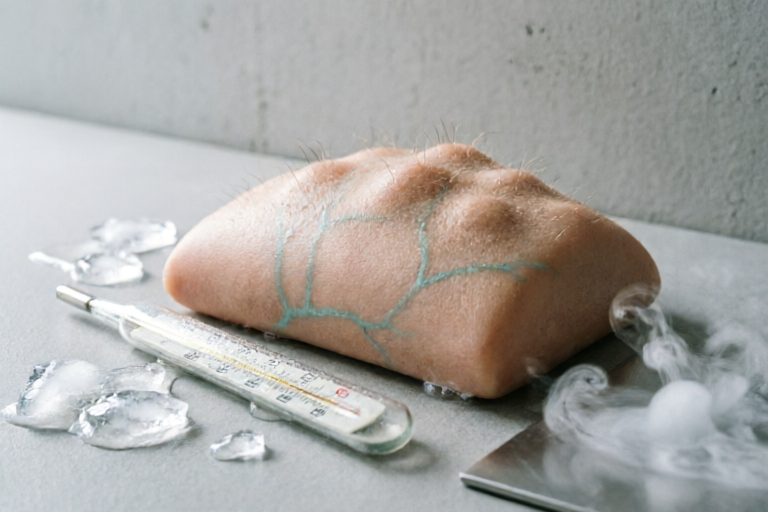
Why Do We Get Goosebumps When Feeling Cold?
Your Body's Ancient Whisper in a Modern World
Why Do We Get Goosebumps When Feeling Cold?
We have all experienced it. Walking out into a biting winter breeze without a heavy coat, or suddenly feeling a chill run down your spine after hearing a startling sound. Your skin instantly breaks out in little bumps, raising tiny hairs in what seems like a pointless reaction. You have goosebumps. But have you ever wondered why our bodies do this? It feels counterintuitive, especially considering that humans are mostly hairless compared to other mammals.
This common physical phenomenon is far more than just a minor annoyance; it is a window into our evolutionary past, a testament to our biological wiring, and a complex interaction between our nervous system and environment. Understanding why we get goosebumps allows us to appreciate the intricate design of the human body, which still carries relics of survival strategies that were crucial thousands of years ago.
Understanding the Phenomenon of Goosebumps
Defining the Experience
The colloquial term "goosebumps" describes a condition where the small muscles attached to the base of each hair follicle contract, causing the hair to stand up vertically. This results in a raised appearance on the skin surface, resembling the texture of a plucked goose feather. In medical terminology, this process is known as piloerection.
The sensation itself is distinct. Often accompanied by a drop in body temperature, it is triggered almost immediately when the ambient temperature falls below the body's comfort zone. However, the reaction is not limited to thermal regulation. It is a visible sign of autonomic nervous system activity, signaling that the body is reacting to external stimuli automatically, without conscious thought.
The Immediate Physical Reaction
When the air temperature drops, the skin cools down rapidly. Thermoreceptors located just beneath the epidermis detect this change and send signals to the brain. The brain interprets this as a threat to homeostasis—the body's internal balance. The immediate goal becomes retaining heat. The physical manifestation of this effort is the puffing up of the skin. While it may seem ineffective now, in earlier stages of human existence, this response served a vital purpose. The raised hairs create a thin layer of trapped air next to the skin, theoretically insulating the body against the cold.
The Biological Mechanism Behind Shivering Skin
The Role of the Autonomic Nervous System
To understand how goosebumps happen, we must delve into the autonomic nervous system, specifically the sympathetic branch. This system controls involuntary bodily functions, such as heart rate and digestion. When you encounter a sudden drop in temperature or a stressor, the sympathetic nervous system goes into alert mode.
The brain, particularly the hypothalamus which acts as the body's thermostat, processes the thermal information. It then sends electrical impulses via nerve fibers to the tiny muscles responsible for moving the hair follicles. These muscles are controlled involuntarily, meaning you cannot consciously decide to raise or lower your goosebumps. They operate independently of your will, driven by the chemical messengers released during the fight-or-flight response.
Anatomy of the Arrector Pili Muscle
At the microscopic level, the key player is the arrector pili muscle. This is a tiny bundle of smooth muscle fibers that anchors the hair follicle to the dermis. One end of the muscle attaches to the middle of the hair follicle, while the other end attaches to the connective tissue of the dermis.
In a relaxed state, the hair lies flat against the skin, allowing for airflow and cooling. However, when the nerve signal arrives, norepinephrine is released. This neurotransmitter binds to receptors on the arrector pili muscle, causing it to contract. As the muscle pulls, it pushes the hair follicle upright. Simultaneously, the contraction causes the skin around the follicle to bulge upward, creating the characteristic bumpy texture we recognize as goosebumps.
This mechanical action is robust. Even though the muscle is microscopic, there are millions of them across the human body. In species with thick fur, like dogs or bears, the contraction creates a dense barrier of air-trapping fur, which significantly boosts insulation. In humans, with our relatively sparse body hair, the effect is largely cosmetic, yet the mechanism remains identical.
Thermoregulation and Heat Conservation
The primary biological imperative of this mechanism is thermoregulation. By standing hair on end, the body attempts to trap a layer of still air close to the skin. Warm air rises and stays trapped in this fluffy layer, acting as a natural blanket. The contraction also reduces blood flow to the surface of the skin through vasoconstriction, minimizing heat loss through radiation. This is part of a broader coordinated response that includes shivering.
Shivering involves rapid muscle contractions in the skeletal muscles to generate heat metabolically. Piloerection works in tandem with shivering. While shivering generates new heat, the raising of the hairs helps conserve existing heat. Together, they form a comprehensive defense strategy against hypothermia and environmental exposure.
Evolutionary Roots: From Fur to Fragile Skin
Ancient Survival Strategies
Why does a nearly hairless primate possess a fully functional furry reflex? The answer lies in deep evolutionary history. Our ancestors, including early hominids and primates, were covered in a dense coat of fur. For these creatures, the ability to fluff their fur was a matter of life and death during cold nights or in high-altitude habitats.
In the savannah, temperatures could plummet rapidly once the sun set. Without the technology of fire or clothing, ancestral humans relied on their physiology to survive. When the cold came, a full coat of fur would expand, creating an insulation layer equivalent to several coats of wool clothing. Similarly, when threatened by a predator, raising the fur would make the animal appear significantly larger and more intimidating. This "panic hair" tactic is still seen clearly in cats arching their backs or dogs puffing up when scared.
The Loss of Fur, Retention of Instinct
As human evolution progressed, we moved toward bipedalism and eventually migrated into varied climates. Some scientists believe we lost our thick body fur to facilitate sweating and cooling in hot environments, allowing for endurance running. The trade-off was losing our built-in insulation. However, evolution is conservative; it rarely deletes a genetic trait entirely if it is not actively harmful.
The neural pathways controlling the arrector pili muscles remained intact. Although the "coat" that used to cover them disappeared, the motor function persisted. We are essentially carrying the hardware of a hairy ancestor within a hairless shell. The genetic blueprint for piloerection is so fundamental to mammalian biology that it was never selected out, even as our reliance on fire and clothing rendered the actual insulation unnecessary.
Vestigial Traits in Modern Biology
Goosebumps serve as a classic example of a vestigial trait—a remnant of an evolutionary feature that has reduced in functionality over time but has not completely vanished. Just as the human appendix is a leftover from a digestive system designed for cellulose-rich plants, goosebumps are a leftover from a furrier past.
This persistence offers biologists insight into human development. It confirms that many of our automatic responses are tied to ancient lineage rather than current necessity. Studying this reflex helps researchers understand how neural circuits are preserved through generations, providing clues about the genetic stability required for basic survival instincts.
More Than Cold: Emotional Triggers
The Phenomenon of Frisson
While cold is the primary trigger, it is certainly not the only one. Many people experience goosebumps when listening to a powerful piece of music, watching an inspiring movie scene, or experiencing intense awe. Psychologists refer to this phenomenon as frisson or "skin orgasms." This reveals that the arrector pili muscles respond not just to temperature, but to strong emotional states.
The connection here is rooted in the same biological pathway. Strong emotions stimulate the sympathetic nervous system just as physical cold does. Whether the trigger is fear, excitement, or aesthetic appreciation, the body releases a cocktail of neurotransmitters, including dopamine and adrenaline.
Mood and Aesthetic Response
When we hear music that resonates deeply—perhaps a crescendo in a symphony, a soulful vocal run, or a sudden chord change—the brain activates reward centers. The anticipation of musical resolution can lead to a spike in physiological arousal. Studies suggest that individuals with higher levels of empathy or sensory processing sensitivity are more likely to experience frisson.
In these moments, the brain perceives the stimulus as emotionally significant enough to warrant a physical reaction, akin to danger or extreme pleasure. The amygdala, the brain region responsible for processing emotions, signals the hypothalamus, which then initiates the muscle contraction sequence. Consequently, you get goosebumps while sitting comfortably in a warm room because your mind interprets the art as a profound event requiring a visceral response.
Fear and Intimidation
Social and existential fears also trigger this reflex. Being caught off guard or facing a threat—real or perceived—activates the fight-or-flight response. In this context, the reflex reverts to its evolutionary root: making oneself appear larger. If a human feels overwhelmed by a situation, the body instinctively tries to mimic the posture of a threatened animal to ward off potential aggression, even if that aggression is abstract or symbolic.
Additionally, the sensation is often linked to social bonding. Shared experiences of awe or collective emotional intensity among a group can synchronize physiological states, potentially strengthening social cohesion. Goosebumps become a shared language of emotional intensity.
Conclusion: An Ancient Reflex in a Modern World
Summary of the Physiological Journey
In summary, goosebumps represent a fascinating intersection of biology, psychology, and history. What begins as a simple physical sensation of cold leads us to uncover the complexity of the sympathetic nervous system, the specific anatomy of the arrector pili muscle, and the evolutionary pressures that shaped our ancestors.
From the contraction of microscopic muscles to the expansion of emotional range, the goosebump is a multifaceted response. It illustrates that our bodies are layered archives of our species' journey, retaining solutions to problems we no longer face daily. We no longer need to fluff our fur to stay warm, nor do we always need to look large to protect ourselves, yet the machinery remains operational.
The Significance of Persistence
Why does this vestigial trait persist in humans? Likely, it serves as a redundant safety net. While clothing covers the skin effectively, the body prefers to maintain its own regulatory systems. Moreover, the link to emotion suggests that the reflex is intertwined with our neurological capacity to feel deeply. Removing it might imply removing a subtle indicator of our emotional landscape.
For researchers, understanding piloerection aids in diagnosing neurological disorders. Conditions affecting the autonomic nervous system can alter or eliminate this response, serving as a diagnostic marker for spinal cord injuries or neuropathy.
Final Thoughts on Human Biology
Next time you feel that tingle on your arms as the wind blows or a song hits a high note, take a moment to appreciate the miracle occurring under your skin. You are witnessing a billion-year-old conversation between your genes, your nerves, and the world around you. The goosebump is a reminder that we are not just modern beings navigating the digital age; we are the descendants of creatures who had to fight the elements, survive predators, and feel the full weight of existence. It is an ancient reflex that continues to echo in the quiet moments of our lives, connecting us to our distant roots and proving that our biology is a living history book waiting to be read.
Comments

Thanks for clearing this up, thought it was just weird skin dryness.

Makes sense for evolution but kinda annoying when I'm hot and sweating 😅

My cat gets like this whenever I scratch his neck. Same thing right?

Great read! Never knew the sympathetic nervous system played such a role here.

So we're basically furry mammals who forgot to keep their coats?

Does anyone else get these during horror movies instead of being cold? 🙋♀️
Never realized hair follicles actually have tiny muscles attached lol. Mind blown.