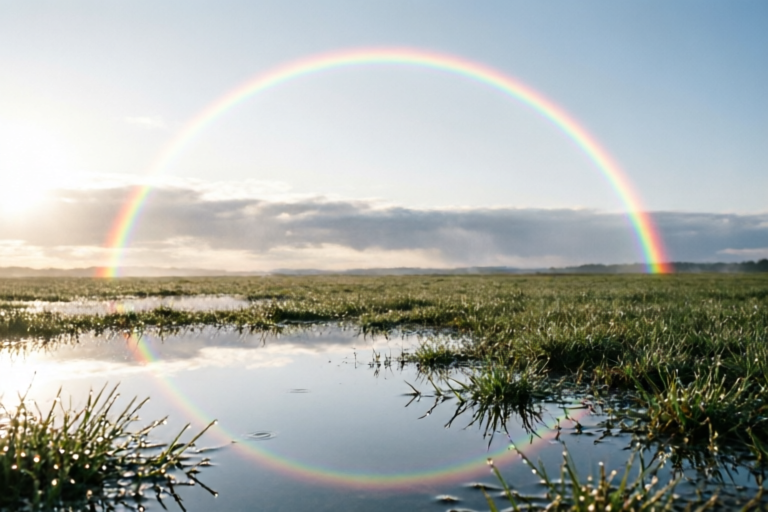
What Causes a Rainbow After Rain?
Unveil the Magic of Rainbows
Introduction to Rainbows
Rainbows are one of nature's most captivating phenomena, often appearing as a multicolored arc in the sky after rainfall. This article delves into the science behind rainbows, exploring what causes them, common misconceptions, and the conditions necessary for their formation.
Definition and Basic Understanding of Rainbows
A rainbow is an optical phenomenon that occurs when light is refracted, reflected, and dispersed within water droplets in the atmosphere. The resulting spectrum of colors is a result of white light being split into its component wavelengths.
Historical Significance and Cultural References
Rainbows have been significant in many cultures throughout history. They are often associated with good fortune, peace, and hope. For example, in Irish folklore, a pot of gold is said to be hidden at the end of a rainbow, while in Norse mythology, a rainbow bridge connects Earth to the realm of the gods.
Common Misconceptions About Rainbows
One common misconception is that rainbows always appear after it rains. In reality, they can also form during fog, mist, or spray from waterfalls. Another myth is that you can find the pot of gold at the end of a rainbow. However, due to the way light interacts with water droplets, this is impossible.
Formation of Rainbows: The Science Behind It
The formation of rainbows involves several key processes: light refraction, internal reflection, and dispersion.
Explanation of Light Refraction Through Water Droplets
When sunlight enters a water droplet, it slows down and bends, or refracts. This bending separates the white light into its constituent colors, each of which has a different wavelength.
Role of Sunlight in Rainbow Formation
Sunlight is essential for rainbow formation. Without direct sunlight, there would be no rainbow. The angle at which sunlight enters the water droplet determines the colors that will be visible.
How Different Angles Create Various Colors
The angle at which light exits the water droplet also affects the colors seen. Red light exits at a slightly larger angle than blue light, creating the familiar red outer band and blue inner band of a rainbow.
Conditions Necessary for Rainbow Appearance
Several conditions must be met for a rainbow to appear:
Importance of Post-Rain Conditions
After rain, the air is filled with tiny water droplets. These droplets act as prisms, splitting sunlight into its component colors. The presence of these droplets is crucial for rainbow formation.
Ideal Weather Scenarios for Optimal Visibility
The best time to see a rainbow is when the sun is low in the sky and the rain has just stopped. This usually happens around sunrise or sunset. Additionally, clear skies in the direction opposite the sun enhance visibility.
Factors Affecting the Intensity and Size of Rainbows
The intensity and size of a rainbow depend on the number and size of water droplets in the air. Larger droplets produce brighter and more vivid rainbows, while smaller droplets result in fainter ones.
Types of Rainbows: Double, Twinned, and More
Rainbows come in various forms, each with its own unique characteristics.
Explanation of Double Rainbows and Their Causes
A double rainbow occurs when light undergoes two reflections inside a water droplet before exiting. This results in a second, fainter rainbow above the primary one. The colors of the double rainbow are reversed, with red on the inner side and violet on the outer side.
Discussion on Twinned and Other Rare Types of Rainbows
Twinned rainbows are less common and occur when two rainbows merge at the top but remain separate at the bottom. Other rare types include supernumerary rainbows, which appear as additional faint arcs inside the primary rainbow.
Differences Between Primary and Secondary Rainbows
The primary rainbow is the most common and brightest. It appears when light undergoes one internal reflection within a water droplet. The secondary rainbow, which is fainter and has reversed color order, forms when light reflects twice inside the droplet.
Geographical and Environmental Impact on Rainbows
The visibility and frequency of rainbows can vary depending on geographical location and environmental conditions.
Influence of Geographical Location on Rainbow Visibility
Some regions experience more frequent rain and thus have higher chances of seeing rainbows. Coastal areas and mountainous regions are particularly favorable due to the abundance of moisture in the air.
Effects of Altitude and Atmospheric Conditions
Higher altitudes generally provide clearer skies and fewer pollutants, leading to more vibrant rainbows. Conversely, polluted atmospheres can obscure the colors, making rainbows less vivid.
Seasonal Variations in Rainbow Frequency
Rainbows tend to be more frequent during certain seasons, especially those with higher precipitation levels. In tropical regions, rainbows may appear more often year-round due to consistent rainfall.
Conclusion: Appreciating the Beauty of Nature's Phenomena
Understanding the science behind rainbows enhances our appreciation of these natural wonders. By observing and learning about rainbows, we can better understand the intricate relationship between light, water, and atmosphere.
Next time you see a rainbow, take a moment to marvel at its beauty and consider the complex processes that create it. Whether it's a simple primary rainbow or a rare double rainbow, each one is a testament to the magic of nature.
Comments

Every time I see a rainbow, I think of pot of gold at the end. Now I know it's just science!

Does the angle of the sun really affect the rainbow's color intensity? That's pretty cool!

This is fascinating! I always wondered how the different colors form. Now it makes total sense.

How come I never see rainbows when it's cloudy after the rain?

I've seen double rainbows before but didn't know why they happen. Cool stuff!
So that's why we see rainbows only after it rains. I always thought it was just a coincidence!

Wow, never knew rainbows could appear at different sizes! This explains why sometimes they seem so big and majestic.