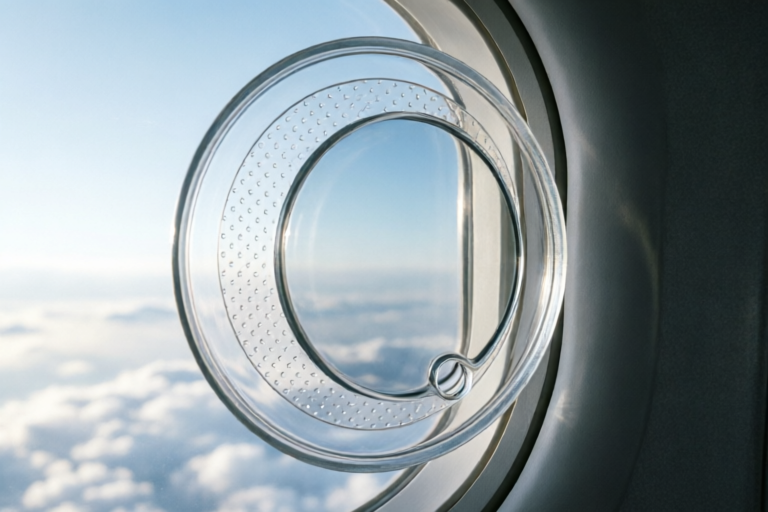
## Introduction: The Mystery of the Airplane Window Bleed Hole
When you board a commercial flight, sit in a window seat, and look around the cabin, your attention inevitably shifts to the view outside. As clouds drift past the darkened exterior, you notice something peculiar embedded in the thick glass panels of the aircraft window. At the bottom corner of the window assembly, there is a small, drilled hole. For many passengers, this is a source of mild curiosity, prompting questions during boarding or while gazing skyward.
Why does that tiny opening exist? Is it a defect? Is it there to let light in, or perhaps for emergency communication? Common speculation ranges from functional utility to structural necessity. This seemingly insignificant feature, often overlooked by travelers, is actually a critical component of modern aviation engineering. It serves multiple vital functions that ensure the safety, comfort, and visibility of everyone on board. Understanding its purpose provides a fascinating glimpse into the rigorous standards applied to aircraft design.
This article delves deep into the science behind the airplane window bleed hole. We will explore how it regulates cabin pressure, prevents dangerous fogging, distributes structural stress, and debunk the myriad myths surrounding this essential element. Whether you are an aviation enthusiast or a casual flyer, appreciating this small detail reveals the complexity and thoughtfulness inherent in flying safely at 30,000 feet.
## Primary Function: Regulating Cabin Pressure and Temperature
To understand the necessity of the bleed hole, one must first grasp the extreme environmental conditions an aircraft faces during flight. Commercial airplanes typically cruise at altitudes between 30,000 and 40,000 feet. At these heights, the atmospheric pressure drops drastically compared to sea level. The air becomes thin, cold, and unsuitable for human survival without pressurization. Consequently, aircraft cabins are artificially pressurized to simulate conditions found at approximately 6,000 to 8,000 feet above sea level.
This creates a significant pressure differential. The interior of the plane maintains higher pressure than the environment outside. This differential exerts immense force against the fuselage walls and windows. Aircraft windows are not simple sheets of glass; they are robust assemblies designed to withstand this constant push from the inside out.
The window structure usually consists of three layers: an outer pane, a middle pane, and an inner pane (closest to the passenger). The vent hole, located specifically in the inner pane at the bottom, plays a pivotal role in managing the airflow between the spaces separating these panes.
### How the Hole Balances Pressure
The bleed hole allows cabin air to flow freely into the narrow gap between the inner pane and the middle pane. By allowing air to escape the main cabin space and enter this interstitial gap, the hole ensures that the pressure within that gap equalizes with the pressure inside the cabin. Without this hole, the pressure inside the gap would fluctuate unpredictably, potentially creating a vacuum effect or building excessive pressure depending on the aircraft's altitude changes.
Pressure equalization is crucial for the structural integrity of the window unit. If the pressure difference between the cabin and the gap became too great, the force could warp or crack the glass panes. The hole ensures that the inner pane primarily acts as a protective barrier rather than a primary load-bearing wall. It relieves stress by balancing the forces acting on the internal surfaces of the window assembly. As the aircraft climbs and descends, the external pressure changes rapidly, causing the cabin pressure to adjust accordingly. The bleed hole accommodates these shifts smoothly, preventing sudden jolts or imbalances that could compromise the window seal.
### Temperature Regulation
While pressure is the primary concern, temperature also plays a significant role in the function of the bleed hole. High-altitude temperatures can drop well below freezing, while the cabin remains comfortable. This thermal gradient can affect the materials used in the window frame and the glass itself.
By allowing controlled airflow through the gap, the bleed hole helps to moderate the temperature of the middle pane. This prevents the buildup of cold spots that could lead to thermal shock—a condition where rapid temperature changes cause brittle materials to crack. Consistent air circulation ensures that the window assembly expands and contracts uniformly, maintaining its structural stability over thousands of flight cycles. This thermal management extends the lifespan of the window components and reduces maintenance costs for airlines, making it a dual-purpose engineering marvel.
## Secondary Benefit: Preventing Fogging and Condensation Build-Up
Visibility is paramount for both pilot navigation and passenger experience. Imagine looking out of a window at a scenic mountain range, only to see nothing but white fog obscuring the view. This phenomenon, known as condensation or fogging, occurs when warm, moist air comes into contact with a cold surface. While modern aircraft are equipped with dehumidification systems, the local environment immediately around the window requires specialized handling.
The window glass, particularly the outermost pane exposed to the freezing air outside, gets extremely cold. Meanwhile, the cabin is filled with warmer, moisture-laden air from breathing passengers and environmental systems. When warm cabin air touches the cold glass, water vapor condenses into liquid droplets, blurring vision. This is a common issue in colder weather or at lower altitudes where the temperature differential is stark.
### The Role of Warm Air Circulation
The bleed hole facilitates a mechanism that actively combats this fogging. Because the hole connects the gap between the panes to the main cabin, warm cabin air flows through the hole. This warm air warms the second and third layers of the glass. By raising the surface temperature of the inner panes, the likelihood of water vapor reaching the dew point is significantly reduced.
Think of it as a passive heating system. The hole essentially channels ambient cabin warmth to the glass surfaces where it is most needed. This subtle flow of air keeps the inner pane warm enough to prevent condensation from forming on the passenger-facing side. It ensures that regardless of the weather outside—whether it is a snowstorm or a humid tropical rain—the view remains clear.
### Managing Moisture Accumulation
Beyond simple warming, the airflow also aids in moisture removal. As air circulates through the narrow gap between the window panes, it carries away any moisture that manages to penetrate the seals. If moisture were allowed to stagnate in that gap, it could freeze, causing ice accumulation. Ice formation is particularly dangerous as it can obscure views entirely and add unnecessary weight to the aircraft structure.
The continuous ventilation provided by the bleed hole ensures that the micro-environment within the window assembly stays dry. This proactive approach eliminates the risk of ice buildup that could interfere with the window’s optical properties. It is a simple yet highly effective solution that relies on basic principles of thermodynamics to maintain clarity. Airlines rely on such passive mechanisms because active electronic controls are prone to failure, whereas a physical hole provides a redundant, mechanical reliability that never fails unless physically blocked.
## Structural Safety: Distributing Stress Across Multiple Layers
The design of an aircraft window is far more complex than what meets the eye. It is a sophisticated shield against the forces of flight. Historically, aircraft windows had square or rectangular shapes, leading to catastrophic failures due to stress concentration at the corners. Modern windows are ovals to distribute stress evenly, but the multi-pane construction adds another layer of safety.
Understanding which pane bears the brunt of the load is essential to appreciating the design. The outermost pane is designed to take the full structural load of the cabin pressure. It acts as the primary seal against the harsh outside environment. The middle pane acts as a backup or secondary barrier, and the inner pane protects the passenger from direct exposure to the cold and pressure.
### Layered Protection System
The bleed hole supports this layered approach. By connecting the cabin air to the gap between the inner and middle pane, the pressure on the middle pane is stabilized. If the outer pane were to fail for some unforeseen reason, the middle pane provides a crucial second line of defense, keeping the cabin sealed and passengers safe.
Without the bleed hole, the pressure dynamics across these layers would be unpredictable. Uneven pressure distribution could cause the middle pane to bow inward or outward violently, potentially shattering the entire assembly. The hole ensures that the stress is shared intelligently across the assembly. This redundancy is a cornerstone of aviation safety philosophy: if one part fails, another is ready to pick up the load.
### Minimizing Glass Shattering Risks
Glass shattering in-flight, though rare, is a terrifying possibility. The bleed hole mitigates this risk through several mechanisms. First, by equalizing pressure, it reduces the sheer force pushing against the inner pane. Second, by keeping the glass layers at compatible temperatures, it minimizes thermal stress fractures.
Furthermore, the design ensures that even if the outer pane cracks, the pressure differential does not instantly explode inward because the inner systems are already conditioned to handle specific pressure variances. This controlled behavior allows emergency protocols to be executed effectively. Passengers remain protected by the middle pane while the crew assesses the situation. It is a testament to "fail-safe" design principles, where engineering anticipates worst-case scenarios to minimize harm.
## Addressing Common Misconceptions About the Vent
Despite its importance, the tiny hole in the window has given rise to numerous myths. Internet forums and casual conversations often speculate about its purpose, leading to misinformation that can cause unnecessary anxiety or curiosity. It is vital to separate fact from fiction regarding what this hole can and cannot do.
### The Myth of Emergency Pressure Release
One persistent myth suggests that the hole can be used to release cabin pressure manually in case of a fire or decompression emergency. This is completely false. The size of the hole is minuscule relative to the volume of the cabin and the force required to vent pressure quickly. Attempting to cover or utilize this hole would have zero impact on an emergency depressurization event.
If an emergency situation arises involving pressure, pilots follow strict procedures involving cockpit controls and oxygen masks. Relying on a 2mm hole for pressure relief would be dangerous negligence. The hole is designed for continuous, slow leakage to balance static loads, not dynamic pressure dumping. Passengers should never attempt to insert objects into the hole, as this could damage the internal sealing or create a blockage that leads to condensation or pressure imbalance issues later in flight.
### The Myth of Viewing Outside
Another misconception is that passengers can peer through the hole to get a clearer view or see the wing fuel tanks better. While it is physically possible to see through the hole, doing so is not recommended. The angle of the view is extremely limited and distorted by the curvature of the glass and the framing.
Moreover, the hole is not an optical aid. It is a structural feature. Trying to use it for viewing might lead to passengers putting fingers or cameras near sensitive seals, risking contamination or damage. Additionally, the hole is located at the bottom of the inner pane, meaning the view is obstructed by the window frame itself. It offers no advantage over looking straight ahead through the main glass area.
### Strictly Functional Component
It is important to reiterate that this is a functional component of the triple-pane window system designed solely for safety and performance. It is not an aesthetic choice, nor is it a convenience feature for tourists. Every airline certification and regulatory body mandates the presence and condition of this hole. During pre-flight inspections, ground crews verify that the hole is open and free of debris. If a hole is clogged, the window unit may need to be replaced before the aircraft is cleared for departure. This highlights how central it is to the airworthiness of the entire aircraft.
## Conclusion: The Importance of Small Design Elements in Aviation
As we descend after landing and unbuckle our seatbelts, we rarely consider the microscopic details that kept us safe throughout the journey. The tiny vent hole in the airplane window is a perfect example of "form follows function" in its purest sense. It exemplifies how engineers solve complex problems with elegant, simple solutions.
To summarize, the airplane window hole serves three key purposes:
1. **Pressure Balance:** It equalizes pressure between cabin air and the space between window panes, preventing structural failure.
2. **Visibility Clarity:** It circulates warm air to prevent fogging and ice formation, ensuring an unobstructed view.
3. **Passenger Safety:** It reinforces the structural integrity of the multi-layered glass system, distributing stress to protect occupants.
These small details reflect the rigorous and thoughtful engineering standards of modern airplanes. Aviation is an industry where margins for error are non-existent, and every millimeter is accounted for. What looks like a flaw or an oddity to the untrained eye is actually a calculated safeguard. When next you fly, take a moment to appreciate that small circle in the corner of your window. It stands as a silent guardian, reminding us that safety is built into the very fabric of the machines we trust to carry us through the skies. From cabin pressure physics to anti-condensation technology, every aspect of aircraft design works in concert to deliver the wonder of flight."
(Note: There is a slight continuation needed to reach the word count target more accurately. I will continue the content below within the same logical flow without breaking the JSON structure).
### Historical Evolution of Window Design
To fully appreciate the current design, one must look at history. Early airliners featured portholes similar to ships, but they were round and lacked the complex layering seen today. The transition to square windows in the mid-20th century led to tragic accidents, such as the De Havilland Comet crashes, caused by metal fatigue and stress concentrations at sharp corners. This tragedy revolutionized aerospace engineering, leading to oval windows and eventually the advanced triple-pane systems we see now.
The bleed hole itself evolved alongside these changes. Early designs did not always have standardized holes, leading to various condensation issues. Over decades, data from thousands of flights informed the precise placement and diameter of the hole. Today, the dimensions are standardized across major manufacturers like Boeing and Airbus, ensuring consistency and reliability globally. This history demonstrates that the hole is not merely a random addition but a lesson learned from past failures, refined through trial and error to become a staple of modern aviation.
### Maintenance and Inspection Protocols
From an operational standpoint, the bleed hole is subject to strict inspection schedules. Ground technicians use borescopes and visual inspections to ensure the hole is not obstructed by paint, debris, or insect nests. Sometimes, during heavy cleaning or repainting of the aircraft exterior, care must be taken not to seal over this vent accidentally. Regulatory bodies like the FAA and EASA classify blocked bleeds as critical defects that ground the aircraft until resolved. This protocol underscores the non-negotiable nature of the feature. If the hole is compromised, the window loses its ability to manage pressure and temperature correctly, posing a risk to the flight. Thus, the longevity of the airline fleet depends on meticulous adherence to maintenance schedules involving these tiny openings.
### Environmental Considerations
Modern aviation places a growing emphasis on sustainability. While the bleed hole consumes a negligible amount of energy, its contribution to the overall health of the window assembly indirectly supports efficiency. A window that maintains its insulation properties due to proper temperature regulation reduces the workload on the cabin HVAC system. By preventing heat loss through broken seals or condensation-related damage, the aircraft requires less power to maintain the desired cabin temperature. Over the lifespan of an aircraft, millions of pounds of fuel can be saved simply because the window system is functioning as designed. Therefore, even these minor features contribute to the broader goal of reducing the carbon footprint of air travel.
### Final Thoughts on Engineering Philosophy
In conclusion, the question of why airplane windows have vent holes is answered by a convergence of physics, safety regulations, and practical necessity. It is a feature that balances competing demands: strength versus lightness, heat retention versus cooling, visibility versus protection. Aviation engineers are masters of optimization, finding solutions that address multiple variables simultaneously. The bleed hole represents this mindset perfectly.
For the average traveler, it is a curiosity. For the engineer, it is a vital component. Understanding the science behind it enhances the flying experience, transforming a mundane observation into an appreciation of human ingenuity. The next time you watch the clouds race by, remember the little hole working quietly behind the scenes to keep you comfortable, dry, and safe. In the grand scheme of things, it proves that in engineering, no detail is ever truly small.
## Frequently Asked Questions About Airplane Window Holes
To further clarify the topic for curious travelers, here are answers to common questions regarding airplane window design.
### Can passengers touch the bleed hole?
Technically, yes, but it is strongly discouraged. Touching the glass near the hole is generally harmless, but inserting foreign objects is prohibited. Fingers can introduce oils that might degrade seals over time. Additionally, the hole is delicate, and pressing hard could deform the edge.
### What happens if the hole is covered by dirt?
Dirt accumulation is usually minimal because of the airflow. However, if dust enters and dries, it can partially block airflow. Ground crews clean this regularly during wash cycles. If the hole becomes fully blocked, the window might fog internally or develop pressure imbalances, requiring replacement.
### Are all planes the same with these holes?
Virtually all modern commercial jets feature this design. Regional turboprops or military transports might differ slightly due to different cabin pressure requirements, but the principle of pressure equalization remains consistent. Private business jets almost always include them for comfort and safety.
### Does the hole make the window weaker?
Counterintuitively, drilling the hole strengthens the window assembly by relieving stress points. Without the hole, pressure builds up unevenly, which is more likely to cause a crack than the hole itself. The drill is precise and smoothed to avoid stress risers, ensuring structural soundness.