Food & Cooking
Why Does Cutting Raw Onions Make Your Eyes Water?
Slice Smart, Cry Less: The Science of Safe Chopping.
## Introduction: The Universal Kitchen Experience
Few sensations in the culinary world are as universally recognized and universally disliked as the sting of cutting a raw onion. Whether you are a Michelin-starred chef meticulously preparing a fine dining menu or a home cook simply trying to whip up a Sunday dinner, the moment your knife breaches the papery skin of a bulb, the air suddenly transforms. It is a silent assault on the senses, characterized by the sharpness of the vapor and the inevitable burning sensation in the eyes that follows.
This phenomenon has puzzled humanity for centuries. While we have mastered the art of cooking, the simple act of slicing through a vegetable remains a source of frustration for many. We have developed elaborate rituals to mitigate the effect, from breathing through our mouths to holding ice in our mouths, all in an attempt to preserve our dignity while chopping. However, understanding why this happens is the first step toward mastering it.
The purpose of this article is not merely to satisfy curiosity, but to demystify the biochemical warfare that occurs between your knife and the onion cell. By unraveling the complex science behind the tears, we can move past superstition and adopt evidence-based methods to prepare food comfortably. From the molecular structure of the onion to the biological defense mechanisms of the human eye, we will explore the full scope of this common irritation. Ultimately, this knowledge empowers home cooks to take control of their kitchen environment, transforming a painful chore into a seamless task.
## Cellular Damage: The First Step of the Reaction
To understand why onions make us cry, we must first look at what is happening at the microscopic level. An onion is not merely a storehouse of flavor; it is a fortress built for self-defense. In nature, plants have evolved sophisticated chemical strategies to protect themselves from being eaten by pests, animals, and fungi. The onion employs a unique arsenal stored within its cellular compartments, waiting for a trigger to activate.
### The Onion’s Protective Arsenal
Under normal conditions, inside a whole, intact onion, the harmful precursors exist separately. These are sulfur-containing compounds known as amino acid sulfoxides, specifically isopropenylpropenesulfenic acid and related derivatives. They are locked away in vacuoles, small storage sacs within the cells, distinct from the enzymes that can convert them into reactive gases. This compartmentalization ensures the onion does not poison itself while storing its defenses. As long as the layers remain unbroken, the chemistry remains dormant.
### Breaching the Cellular Wall
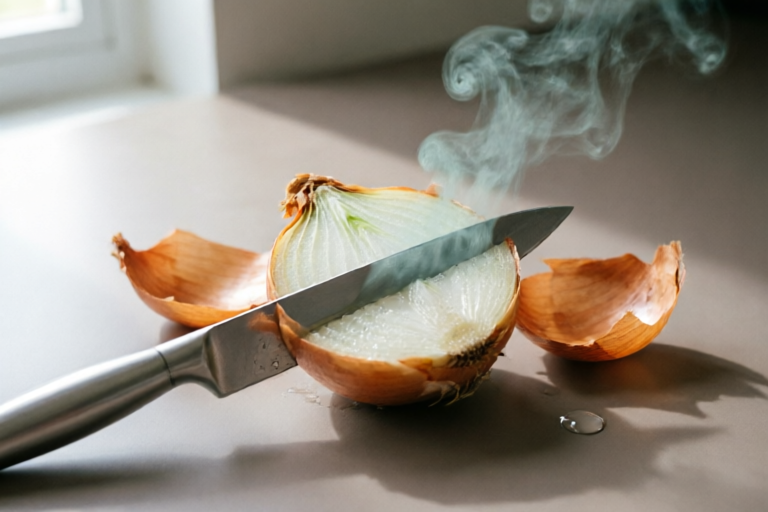
The magic, or rather the mischief, begins when the onion is cut. When your knife presses down upon the vegetable, it crushes the rigid cell walls of the onion layers. This physical trauma creates a breach in the separation mechanism. The vacuoles containing the sulfenic acid precursors burst open, spilling their contents into the cytoplasm where they immediately collide with a powerful enzyme called alliinase. This collision is instantaneous. The structural integrity of the plant tissue dictates the timing and intensity of the tear-inducing reaction.
Different varieties of onions possess varying levels of these sulfur compounds. Sweet onions, such as Vidalias, generally have lower concentrations, resulting in milder vapors and fewer tears. Conversely, pungent varieties like Red Bull or Standard Yellow onions are bred for stronger flavor profiles and higher sulfur content, making them significantly more volatile. The size of the cuts also plays a role; finer chopping increases the surface area exposed to the air, releasing more precursor molecules simultaneously, thus intensifying the reaction.
## Enzymatic Conversion: Creating the Volatile Gas
Once the cellular damage occurs and the precursors mix with the enzyme, a rapid chemical cascade is initiated. This phase is crucial because it transforms stable liquid compounds into a gaseous irritant. The transformation is driven by a specific set of biological catalysts designed to maximize efficiency in milliseconds.
### The Role of Alliinase
Alliinase is the star player in this biochemical performance. Found in the cytoplasm of onion cells, this enzyme acts rapidly once the barrier separating it from the amino acid sulfoxides is removed. It catalyzes the breakdown of the precursors into unstable intermediates. Specifically, it converts the sulfoxides into sulfenic acids. This process releases a significant amount of energy and sets the stage for the final product. Without this specific enzyme, the reaction would not occur, and cutting an onion would remain a mundane kitchen activity rather than an ordeal.
### Syn-Propanethial-S-Oxide Explained
The immediate products of the alliinase reaction are various types of sulfenic acids. However, these are still relatively unstable and reactive. They quickly undergo a rearrangement facilitated by another enzyme, known as lachrymatory-factor synthase. This enzyme is unique to certain species of the Allium family, including onions, and is responsible for converting the sulfenic acids into a single, potent compound: syn-propanethial-S-oxide.
This gas is light and highly volatile. It evaporates almost instantly after the cutting is complete, wafting upward from the surface of the cut onion. Unlike other kitchen smells that linger, this molecule seeks out moisture and surfaces it comes into contact with, particularly the moist tissues of the human eye. Its volatility is the reason why you cannot see it, yet you feel it so acutely. It is essentially a form of natural pepper spray released by the vegetable.
Syn-propanethial-S-oxide diffuses quickly in the air. The concentration depends on the variety of the onion and the temperature of the room. Warmer temperatures increase the kinetic energy of the molecules, causing them to spread faster and react more vigorously. This is why leaving a cut onion out on a warm counter can make the scent even more overpowering compared to a refrigerated one. The stability of the gas is fleeting; once it reacts with something, like the moisture in your eye, it is neutralized, triggering the body’s defense system.
## Physiological Response: Why Eyes Produce Tears
Once the gas reaches your face, the real drama unfolds within your physiology. The human body perceives syn-propanethial-S-oxide as an irritant, similar to dust, smoke, or a strong chemical solvent. It is not toxic in the quantities produced during cooking, but the nervous system treats it as a threat that must be neutralized immediately.
### The Tear Duct Trigger
The cornea of the eye is incredibly sensitive. It is packed with nerves belonging to the trigeminal nerve, one of the main cranial nerves responsible for sensory processing in the head. When the onion gas dissolves in the thin layer of fluid covering the cornea, it forms a dilute solution of sulfuric acid. This mild acidity triggers a firing alarm across the trigeminal nerve fibers.
The brain receives this signal and interprets it as foreign material or potential injury to the delicate eye tissue. The automatic response is to flood the eye with tears. This is mediated by the lacrimal gland, located above the outer corner of each eye. Upon stimulation, the gland releases a surge of aqueous fluid. This reflex tearing is involuntary; you cannot consciously stop your eyes from watering because the response is hardwired into the autonomic nervous system.
### Lavender’s Law: Dilution Mechanism
The primary function of tears is protection. The sudden influx of tears serves two purposes: dilution and flushing. First, the tears dilute the irritant, reducing its concentration until it is no longer harmful. Second, the flow carries the irritant away, washing it out of the eye and preventing prolonged exposure. The excess fluid causes the familiar heavy feeling under the eyes and the redness associated with intense crying.
It is interesting to note that emotional crying and onion-induced crying trigger different pathways. Emotional tears contain proteins and hormones, whereas onion tears are primarily saline water aimed at rinsing the corrosive agent. However, because the trigeminal nerve overlaps with some emotional centers, the stress of the situation can sometimes exacerbate the tearing, making it feel like genuine sadness or frustration.
The duration of the reaction lasts only as long as the concentration of the gas remains high enough to stimulate the receptors. Once the gas dissipates or you leave the vicinity of the cut onion, the flow subsides. Understanding this physiological loop helps explain why ventilation is critical; moving the air removes the stimulus, allowing the lacrimal glands to return to baseline production rates.
## Preventative Measures for Home Cooks
While we cannot change the biological makeup of the onion, we can manipulate the environment and our tools to minimize the release and impact of the irritant gas. There are several proven methods that utilize physics, chemistry, and mechanical advantage to keep your eyes dry while you chop.
### Temperature Control Strategies
One of the most effective methods involves cold temperatures. Chemical reactions slow down in colder environments. Placing the onion in the refrigerator for about 30 minutes before cutting reduces the activity of the enzymes within the cells. Because the volatilization rate of the gas is temperature-dependent, chilling the onion significantly slows the production of syn-propanethial-S-oxide.
Some chefs even freeze onions briefly, though care must be taken not to turn the entire bulb into an icy rock. A cool onion releases less gas because the kinetic energy required for the molecules to escape into the air is lower. This makes the vapor less pungent and allows your immune system to handle the low-level irritation without flooding the eyes.
### Blade Techniques and Tools
Using a sharp knife is non-negotiable for minimizing irritation. A dull blade bruises and crushes the onion cells rather than slicing through them cleanly. Crushing creates more chaotic damage and ruptures more vacuoles simultaneously, releasing a larger cloud of gas. A razor-sharp blade severs the cells neatly, causing less collateral damage and preserving the integrity of the remaining onion.
Beyond the blade, consider the shape of the cut. Long vertical slices expose less surface area to the air compared to mincing the onion into tiny cubes. Keeping the root end intact until the last moment is also a time-honored tip. The roots contain a higher concentration of the sulfur compounds and the precursors. Leaving the root attached keeps the bulk of the chemicals contained until the very end, limiting the overall release during the main preparation phase.
### Environmental Adjustments
Controlling the air movement in the kitchen is perhaps the simplest strategy. Using a fan or opening a window helps disperse the gas before it can reach your face. Positioning the fan so it blows the air sideways or upwards prevents the gas from traveling directly into your sinuses. Additionally, cooking near a stove with an exhaust hood turned on creates a downward airflow that pulls the rising gas away from your eyes and vents it outside.
### DIY Remedies Worth Trying
Some cooks advocate for chewing gum while cutting onions. The theory is that the constant jaw movement promotes salivation, and some believe this distracts the nose or alters breathing patterns enough to reduce intake. Others suggest wearing goggles or swimming glasses. While unconventional, this creates a physical barrier completely sealing the eye area from the air.
Another trick is to hold a piece of bread or a candle flame nearby. Some studies suggest that the heat of a candle can encourage the gas to burn off or rise before reaching you, though the effectiveness varies widely. Submerging the onion in water before cutting is another option. Since the precursors dissolve in water, soaking the onion before slicing can wash away some of the chemicals. However, this can affect the texture and flavor, so it is best reserved for recipes where wet ingredients are acceptable.
## Conclusion: Nature’s Built-In Protection
The mystery of the weeping onion is resolved not by fear, but by understanding the intricate dance of biochemistry and evolution. What initially appears to be an annoyance is actually a testament to the resilience and defensive capabilities of nature. The onion uses syn-propanethial-S-oxide as a deterrent, ensuring that it is not consumed by predators until it is ripe and ready to reproduce. Our tears are the unfortunate side effect of our own sensitivity to this warning signal.
By grasping the mechanics of cellular damage, enzymatic conversion, and physiological response, we gain the power to outsmart this ancient defense system. Whether you choose to chill your vegetables, sharpen your blades, or ventilate your workspace, the goal is the same: to bring order to the chaos of cooking. With the right knowledge, the kitchen becomes a place of creation rather than discomfort.
Ultimately, cutting onions is more than just a cooking step; it is a lesson in food chemistry. It reminds us that the ingredients we use every day are living relics with their own histories and defenses. Next time you stand over a cutting board, remember that your tears are the price of flavor, but they do not have to be a necessity. Empower your culinary journey with science, and enjoy the taste without the sting.
In summary, the science of onions is a perfect intersection of botany, chemistry, and anatomy. It offers valuable lessons on how organic matter interacts with the human body and how simple adjustments in technique can yield significant improvements in daily life. Embrace the challenge, master the technique, and turn the table on the onion. Your eyes will thank you, and your meals will be safer to prepare.
Comments

GrumpyGus
finally someone explained it properly instead of just saying 'cut slowly'
👍 7👎 0

TearStains
okay so the gas floats up? that explains why standing above the bowl hurts more
👍 4👎 0

LabCoatLife
it's funny we treat plants like servants while they fight back chemically
👍 2👎 0

AskAnything
but why evolutionarily did they decide to do that lol?
👍 5👎 0

ShortAndSweet
made me respect onions way more than i did before
👍 26👎 0

SunnyDay
the freezer trick is legit though. saves so many tissues tbh
👍 21👎 0
OnionRipper
never knew it was an enzyme reaction until reading this. good eye opener
👍 3👎 0