Why Does Water Boil Faster at High Altitudes?
Understanding the Science of Water Boiling at High Altitudes
### Article Outline: Why Does Water Boil Faster at High Altitudes?
1. Introduction to Atmospheric Pressure and Its Impact on Boiling Point
Definition of atmospheric pressure and its variation with altitude:
Atmospheric pressure is the force exerted by the weight of the air above a given point. It decreases as altitude increases because there is less air above you. This decrease in pressure has a significant impact on the boiling point of liquids, including water.
Explanation of how atmospheric pressure affects boiling point:
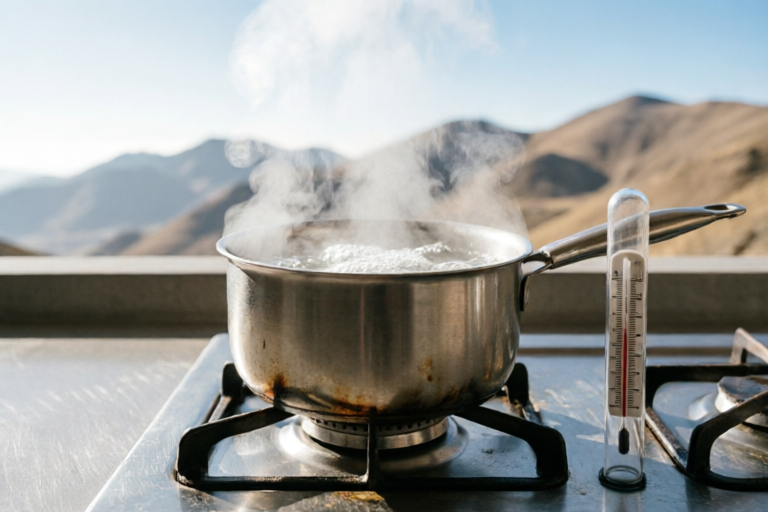
The boiling point of a liquid is the temperature at which its vapor pressure equals the surrounding atmospheric pressure. At sea level, where atmospheric pressure is higher, water boils at 100°C (212°F). However, at higher altitudes, the lower atmospheric pressure means water boils at a lower temperature. For example, at an elevation of 1,500 meters (about 5,000 feet), water boils at around 93°C (199°F).
2. The Science Behind Water Boiling at Different Altitudes
Molecular explanation of why water boils faster at higher altitudes:
Water molecules are constantly moving and colliding. When the temperature reaches the boiling point, enough energy is transferred to the water molecules to overcome the intermolecular forces holding them together. In areas of low atmospheric pressure, like high altitudes, fewer collisions between molecules are needed to escape into the air as steam. Therefore, water boils faster because it takes less energy to reach the boiling point.
Role of vapor pressure in the boiling process:
Vapor pressure is the pressure exerted by a vapor in equilibrium with its liquid or solid phase. As the temperature increases, so does the vapor pressure of the liquid. At the boiling point, the vapor pressure of the liquid equals the atmospheric pressure. In high-altitude regions, the lower atmospheric pressure allows water to reach its boiling point at a lower temperature, making it easier for the water to turn into steam.
3. Practical Implications for Cooking and Survival at High Altitudes
Effects on cooking times and methods:
Cooking at high altitudes can be challenging because the reduced boiling point means food takes longer to cook. For instance, pasta may require more time to become tender, and baking bread might result in denser loaves. Adjustments need to be made in terms of cooking time and temperature to achieve optimal results.
Importance of adjusting recipes for high-altitude environments:
Recipes that work well at sea level may not yield the same results at high altitudes. Baking recipes often need to include additional ingredients like flour or eggs to compensate for the lower atmospheric pressure, which can cause cakes to rise too quickly and then collapse. Additionally, some ingredients like sugar and salt may behave differently, requiring adjustments in quantities.
4. Historical and Cultural Perspectives on High-Altitude Cooking
Traditional practices in high-altitude regions:
Many cultures living in high-altitude regions have developed unique culinary techniques to cope with the challenges of cooking at lower boiling points. For example, the Andean people have long used pressure cookers to increase the boiling point of water, allowing them to cook food more efficiently. Similarly, Tibetan cuisine often incorporates slow-cooking methods and the use of specialized equipment to ensure proper cooking.
Evolution of culinary techniques in response to altitude challenges:
Over time, cooks and chefs have adapted their techniques to account for the effects of high altitude. Modern culinary practices now include specific guidelines for adjusting cooking times, temperatures, and ingredient ratios when preparing meals at higher elevations. These adaptations ensure that dishes remain flavorful and nutritious despite the challenges posed by reduced atmospheric pressure.
5. Comparison with Other Liquids: Do They Behave Similarly?
How different liquids behave under varying atmospheric pressures:
Other liquids, such as milk, alcohol, and oils, also experience changes in boiling points at high altitudes. However, these changes are not always as pronounced as those seen in water. For instance, milk contains proteins and fats that affect its boiling behavior, while alcohol has a much lower boiling point than water and is more volatile at high altitudes. Oils, on the other hand, have higher boiling points and are less affected by atmospheric pressure changes.
Unique properties of water that make it distinct from other substances:
Water's unique molecular structure and high heat capacity make it particularly sensitive to changes in atmospheric pressure. Its ability to dissolve many substances also plays a role in how it behaves at different altitudes. Unlike other liquids, water's boiling point is directly tied to atmospheric pressure, making it an excellent indicator of environmental conditions.
6. Conclusion: Understanding and Adapting to High-Altitude Conditions
Recap of key points discussed in the article:
This article explored the relationship between atmospheric pressure and the boiling point of water, highlighting how water boils faster at higher altitudes due to lower atmospheric pressure. We delved into the molecular and scientific explanations behind this phenomenon and examined its practical implications for cooking and survival. Additionally, we touched upon historical and cultural perspectives on high-altitude cooking and compared water's behavior to other liquids.
Final thoughts on the importance of understanding boiling point changes at high altitudes:
Understanding the science behind water boiling at high altitudes is crucial for anyone living or traveling to elevated regions. By adapting cooking methods and recipes to account for these changes, individuals can ensure that their meals are both safe and delicious. Whether you're a seasoned mountaineer or simply curious about the natural world, grasping this concept opens up new possibilities for exploration and culinary creativity.
Comments

Great info! Adjusting recipes is key when you're above sea level.

Interesting! Will keep this in mind for my next camping trip.

When I travel to high altitudes, my pasta takes forever! Now I know why.

The vapor pressure explanation makes so much sense. Thanks for breaking it down!

How does this affect baking at high altitudes? Should I change my oven temperature too?

I live in the mountains and always adjust my cooking times. This explains why!

Wow, never knew water boiled faster up here! Always thought it was just because it's colder.