Food & Cooking
Why Do Popcorn Kernels Pop When Heated Quickly?
Nature's Own Pressure Cooker: Unlock the Science Behind Your Snack
# Why Do Popcorn Kernels Pop When Heated Quickly?
## The Mystery of the Exploding Kernel
There is nothing quite like the smell of fresh popcorn wafting through a room. It is a scent that triggers memories of movie nights, fairs, and cozy family gatherings. Yet, amidst the anticipation of that sweet or salty crunch lies a phenomenon that is both magical and mysterious. How does a small, hard seed transform into a large, fluffy cloud of edible white matter? Why does it happen so suddenly with such a definitive pop? For centuries, the answer was a simple culinary secret passed down through generations, but today, we understand it as a triumph of thermodynamics and biology.
Popcorn is unique among grains. While other varieties of corn (Zea mays) soften when cooked or harden into dense flakes, popcorn kernels possess a specific structural integrity that allows them to withstand immense pressure before releasing it in an explosive burst. This behavior defies the usual expectations of cooking. Typically, heating food causes it to soften, dry out, or melt gradually. Popcorn, however, refuses to budge until a precise threshold is met, at which point it undergoes a violent structural transformation. Understanding this process is not merely a curiosity for scientists; it is a lesson in how pressure vessels work, how phase changes occur, and how nature engineers complex materials.
In this comprehensive guide, we will dissect the anatomy of the popcorn kernel, explore the intense thermodynamic processes required to trigger the pop, and analyze the chemical reaction that turns a hard stone into a soft treat. By understanding the physics of popping, we gain deeper appreciation for the snack itself and learn valuable principles that apply far beyond the kitchen. Whether you are trying to stop your unpopped kernels or simply wishing to impress guests with your knowledge, grasping the mechanics of the pop is essential.
Anatomical Structure: Water, Starch, and the Hull
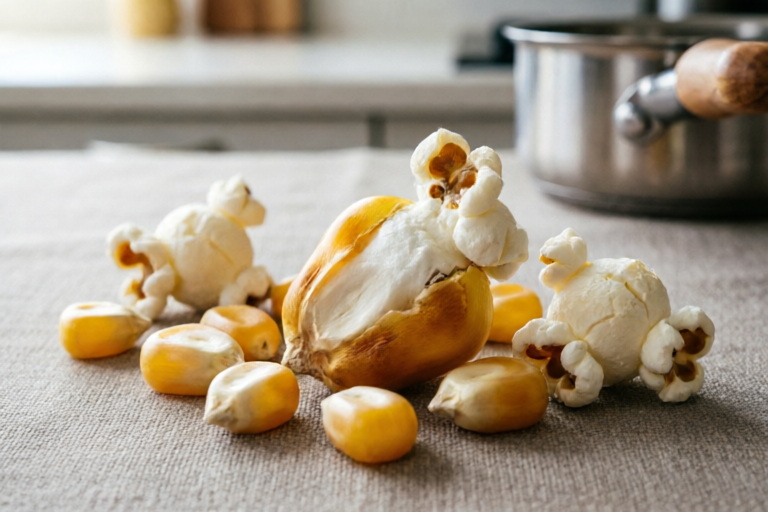
To truly understand why popcorn pops, we must first look at what is happening at a microscopic level. A popcorn kernel appears to be a solid object, but biologically, it is a complex package designed for dormancy and survival. It consists of three primary components: the hull (also known as the pericarp), the endosperm, and the germ. Each of these plays a critical role in the popping event, acting as either a reservoir, a reactant, or a container. ### The Impermeable Outer Shell The most critical component for the popping mechanism is the hull. This thin, brittle outer shell encases the interior contents entirely. Unlike the shells of wheat or rice, which allow for some permeability, the pericarp of the popcorn kernel is virtually impermeable to moisture and gases under normal conditions. This hardness is achieved through a high concentration of cellulose and silica, making it resistant to mechanical stress and biological decay. This impermeability is the reason popcorn does not simply dry out or rot easily during storage; the seed life is preserved inside a sealed vault. However, this strength is also its potential weakness. Because water vapor cannot escape the hull easily during the heating process, pressure begins to build rapidly. In engineering terms, the popcorn kernel acts as a tiny pressure vessel. If the hull were permeable or structurally weak, the steam produced would leak out slowly, resulting in dried corn rather than popped popcorn. The hull must remain intact until the exact moment the explosion occurs, forcing it to become the limiting factor in the system. ### The Endosperm: A Storehouse of Starch and Water Inside the protective hull lies the endosperm. This is the starchy part of the kernel that eventually transforms into the fluffy white substance we eat. The endosperm contains granules of starch (mostly amylopectin and amylose) suspended in a matrix of proteins and enzymes. Crucially, hidden within this starchy mass is moisture. Popcorn kernels require a specific moisture content to function correctly, typically ranging between 13% and 14% by weight. This water is not free-flowing; it is trapped within the molecular structure of the starch granules. If the kernel dries out too much—dropping below 12% moisture—the internal pressure cannot reach the necessary level to rupture the hull, resulting in an "old maid," a kernel that never pops. Conversely, if the kernel is too wet (above 15%), the hull may become too soft or prone to premature leakage, leading to tough, chewy popcorn rather than a light, airy texture. Therefore, the exact moisture percentage is the variable that cooks manipulate to achieve consistent results.Thermodynamic Process: Steam Pressure Builds Up
Once we understand the anatomy, we must introduce the catalyst: heat. The journey from raw kernel to fluffy popcorn is a textbook example of thermodynamics in action. As heat energy is applied to the kernel, it travels through the hull via conduction (if touching a hot surface) or radiation (microwave) or convection (hot oil or air). ### The Phase Change of Water As the internal temperature of the kernel rises, the water molecules trapped within the endosperm gain kinetic energy. In liquid form, these molecules vibrate and move relatively slowly. As the temperature approaches the boiling point of 100 degrees Celsius (212 degrees Fahrenheit), the water begins to boil. However, because the hull prevents the steam from escaping, the water cannot transition to a gas freely. This creates a state of superheating. In a pressurized environment, water remains liquid even above its standard boiling point. Within the kernel, temperatures can rise well past 180 degrees Celsius (356 degrees Fahrenheit) while the water remains in a liquid or semi-liquid state. During this time, the pressure inside the kernel increases dramatically according to Gay-Lussac's law, which states that pressure is directly proportional to temperature for a fixed mass of gas. Since the volume of the hull is relatively constant, the rising temperature forces the internal pressure skyward. ### Critical Pressure Thresholds Calculations suggest that for the pop to occur, the internal pressure must reach approximately 9 atmospheres (roughly 135 psi). At this critical pressure point, two things are happening simultaneously. First, the temperature reaches the glass transition temperature of the starch. Second, the structural integrity of the hull is approaching its ultimate tensile strength. The steam inside is compressing the starch granules into a dense, viscous paste. The kernel is essentially a bomb waiting to detonate, holding massive amounts of potential energy in the form of compressed steam. This phase is invisible to the naked eye. To an observer, the kernel simply sits there, perhaps warming up and expanding slightly as the materials stretch. But internally, a war is brewing. The steam is pushing outward with tremendous force, and the hull is pushing back with equal resistance. The system is in dynamic equilibrium until one side wins. This explains why the pop seems instantaneous; once the equilibrium is broken, the release of energy happens faster than our eyes can track.The Explosion: Gelatinization and Fluffiness
The moment of truth arrives when the internal pressure exceeds the structural strength of the hull. This rupture typically happens at around 180 degrees Celsius (356 degrees Fahrenheit). When the seal breaks, the physics shifts from containment to rapid expansion. ### Rapid Expansion of Steam Upon the fracture of the hull, the superheated steam instantly expands. In fact, water expands by a factor of approximately 1,600 times when converting from liquid to gas at atmospheric pressure. This sudden volume increase creates an explosive shockwave that blows the kernel apart audibly. This is the source of the characteristic "pop" sound. Without the rapid release of pressure, the sound would be merely a hiss. The speed of the rupture is what generates the acoustic signature. ### The Formation of Foam: Gelatinization Simultaneously, the hot, viscous starch mixture inside the kernel is subjected to this sudden pressure drop. Before the hull broke, the starch was dense and packed. Once the pressure drops to atmospheric levels, the dissolved starch explodes outward. However, it does not solidify immediately. At this specific temperature range, the starch is in a rubbery, amorphous state known as a glass transition. As the steam pushes the molten starch outward, it bubbles and froths, creating a foam-like structure. Imagine blowing air into a tube of warm toothpaste; it forms soft strands. Similarly, the starch stretches into thin films around pockets of steam. Because this happens in a fraction of a second, the structure does not have time to collapse. The steam escapes, but the starch films remain, trapping the air. ### Hardening the Shape Almost immediately after the explosion, the temperature of the expanding foam drops rapidly as it mixes with the cooler ambient air. This rapid cooling locks the foam structure into a rigid solid. The process is similar to how sugar glass is made or how candy pulls are created. The result is a porous, lightweight cellular network that is crunchy yet airy. This structure is what gives popcorn its mouthfeel. The irregular shapes of the expanded starch create a high surface area-to-volume ratio, which is why butter or salt adheres so easily to the finished product. It is important to note that only certain varieties of corn, specifically Zea mays everta, possess the physical characteristics necessary for this process. Other corns lack the specific hull elasticity or the internal moisture balance required to build sufficient pressure before rupturing. Attempting to pop sweet corn or dent corn will yield different results, typically involving burning the exterior before the interior ever reaches the pressure point.Conclusion: A Simple Lesson in Physics and Chemistry
The humble popcorn kernel serves as a perfect demonstration of fundamental scientific principles. From the impermeability of the cell walls to the properties of ideal gases and the phase transitions of starch, every aspect of popping corn relies on precise physical laws. What seems like a random kitchen occurrence is actually a highly engineered natural phenomenon that rewards patience and proper technique. ### Connecting Kitchen Phenomena to Broader Concepts Understanding the physics of popcorn extends to broader applications. It mirrors the operation of pressure cookers, steam engines, and even rocket propulsion systems, where contained pressure is used to generate force. By mastering the moisture content of your corn, you are managing the fuel load. By monitoring the heat, you are controlling the pressure build-up rate. Even the choice of cooking method matters: microwaves heat the water molecules directly, while stovetop pans conduct heat through the hull. Both lead to the same outcome, but the efficiency varies. Furthermore, this knowledge helps troubleshoot common issues. If you are left with "old maids" (unpopped kernels), the issue is likely insufficient moisture content due to improper storage. If your popcorn is chewy, the heat was applied too slowly, allowing the steam to escape prematurely or the starch to burn. If it burns quickly, the temperature exceeded the flash point before pressure was reached. ### Storage Requirements and Maintenance For consumers, the takeaway is practical. To ensure optimal popping, store popcorn kernels in an airtight container away from humidity and direct heat. Moisture loss is the enemy of popping. Keeping the humidity stable maintains the internal pressure reserve within the endosperm. Additionally, knowing that the hull requires a specific temperature to fail means that pre-heating your pan or microwave is often beneficial to minimize the thermal lag before the pop begins. Ultimately, the next time you watch a bag of kernels explode in a pot, or hear the rapid-fire crackle of a bowlful in the cinema, pause to appreciate the science unfolding before you. It is a celebration of thermodynamics, a victory of biology over entropy, and a delicious reminder that sometimes, the best results come from applying enough pressure to bring something to the breaking point. Popcorn is more than a snack; it is a testament to the power of heat, pressure, and precision combined in perfect harmony.Comments

PopCornLover
I love explaining this to kids during movie nights now. Thanks for the breakdown!
👍 20👎 0

RandomUser123
Good read, definitely helps understand why I shouldn't use wet kernels though.
👍 4👎 0

FoodieGal
Never looked at a kernel the same way again. Who knew biology AND chemistry were working together here.
👍 3👎 0

SteveM_
Cool post! Makes me want to test heating them super slow just to see if they burn instead of pop.
👍 14👎 0

KitchenWiz
This explains why microwave bags have those crinkly parts inside lol. Still waiting for the science to explain butter flavoring though.
👍 14👎 0

QuietThinker
I always wondered why some kernels go 'old' and don't pop anymore. Is it the moisture drying up?
👍 6👎 0
SnackAttack92
So basically it's a tiny pressure cooker trapped in food? Mind blown 🤯
👍 7👎 0